
How To Leverage Contests To Generate Leads
Practical, step-by-step guidance for marketers who want predictable, scalable lead growth from contests.
Contests and giveaways are more than short bursts of attention. When planned and executed correctly they are a powerful lead-generation engine. They help you grow your audience, collect clean contact data, qualify prospects, and create shareable content that fuels organic reach. This guide walks through why contests work, how to design one that delivers qualified leads, promotion and legal musts, measurement, and real examples you can copy.
Why contests work for lead generation
Contests tap three simple human drivers: the chance to win something valuable, the desire to be recognized or featured, and the social urge to share a fun experience. The mechanics let you swap a low-friction action entering with a high-value return: an email, a profile, a referral, or a purchase. When aligned with business goals, a contest can produce quick list growth and provide marketing-qualified signals you can act on.
Data-backed reasons to try contests:
- Lead generation remains a top marketing priority for businesses, and channels that combine incentives with data capture often outperform awareness-only campaigns.
- Well-run sweepstakes and giveaways have produced large audience and revenue lifts for small brands and large corporations alike — demonstrating contests scale from boutique shops to household names.
Types of contests and when to use each
Choose a format that matches your goals and audience.
- Sweepstakes / Raffle (entry form + random draw)
Best for: rapid list growth and broad reach. Low barrier to entry keeps conversion high. - User-generated content (UGC) contests
Best for: engagement, social proof, and building content you can reuse. Ask users to submit photos, videos, or stories related to your product. - Referral contests (viral sweepstakes)
Best for: leveraging existing customers to recruit new leads. Each referral can be an entry multiplier. - Skill-based contests
Best for: higher-quality leads and brand positioning. Use quizzes, challenges, or design contests to attract passionate users. - Social-only contests
Best for follower growth on a platform and short-term buzz. Use platform-native mechanics but always capture an email at some point if lead generation is the goal.
How to plan a lead-generating contest (step-by-step)
1. Set a clear, measurable goal
Pick one primary metric: number of qualified leads, email list growth, social followers, app installs, or direct sales lift. Define what “qualified” means before you start.
2. Pick the right prize

Prize relevance matters more than dollar value. A prize that directly appeals to your target buyer attracts better leads. For example, a boutique running shoe brand would drive higher-quality leads with a year’s supply of running shoes than a generic tablet.
3. Choose the contest mechanics that support your goal
If you want email addresses, require signups. If you want social amplification, add bonus entries for shares or referrals. If conversion is the goal, combine entry with a small purchase or upsell path.
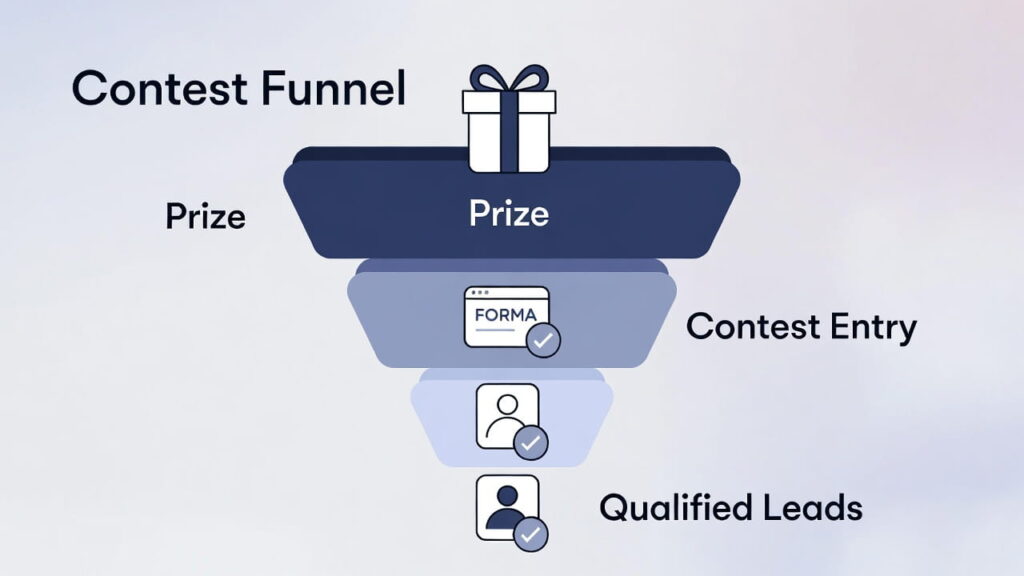
4. Build the funnel and entry form
Keep required fields minimal to maximise entries (name, email), and use progressive profiling for later enrichment. Add optional fields or micro-qualifiers for segmentation (city, product interest). Use hidden UTM parameters and tracking to tie traffic sources back to entries.
5. Decide duration and timeline
Short contests (3–7 days) create urgency. Longer ones (2–4 weeks) give more time for UGC and referrals to spread. Plan pre-launch teasers, launch day, mid-campaign pushes, and final-chance messaging.
Promotion channels and amplification tactics
A contest can only be a lead engine if people see it. Use a mix of paid, owned, and earned channels.
- Paid social ads: target lookalike audiences and retarget visitors. Paid support often multiplies entries and can be highly efficient for contests with a clear conversion flow.
- Email marketing: announce to existing customers, then follow up with reminder and last-chance emails.
- Organic social: pin the contest, use Stories and Reels, and show entries to build social proof.
- Partners and influencers: co-promote to extend reach into relevant audiences. Prize relevance and clear creative make influencer spots more effective.
- On-site placements: homepage banners, pop-ups, and a dedicated landing page with a clear CTA.
- Referral mechanics: reward entrants for sharing with friends; referrals tend to be higher-intent because they come with a personal recommendation. Platforms and apps built for contests simplify referral tracking.
Legal, privacy, and platform rules you must follow
Contests are regulated. Basic legal checklist:
- Create official rules: eligibility, entry method, prize details, selection criteria, and privacy policy link.
- Local laws and sweepstakes regulations: check country and state requirements—some regions restrict lotteries and require bonds or disclaimers.
- Platform rules: each social network has rules for promotions; read and comply to avoid bans.
- Privacy and data handling: be explicit how you will use entrants’ data and provide opt-in choices for marketing communications.
- Tax reporting: large prizes may require reporting; include tax responsibilities in rules.
For a smooth campaign, consult legal counsel for your jurisdiction and use a tool or platform that offers built-in compliance templates. Opt-inMonster and similar guides explain the practical steps for creating rules and landing pages.
Tools and platforms that speed things up
Use contest platforms to manage entries, fraud protection, and winner selection. Popular options provide templates, social entry methods, and viral referral mechanics. ShortStack, ViralSweep and others have case studies showing how brands converted contest leads into revenue. Using a specialized tool reduces backend complexity and helps with compliance.
How to qualify, segment, and follow up leads
Collecting emails is step one. Good follow-up turns entrants into customers.
- Immediate confirmation: send a welcome email and set expectations (winner announcement, frequency of contact).
- Segment by entry behavior: who referred others, who submitted UGC, who clicked prize pages. Use this to tailor follow-up flows.
- Nurture sequence: 3–5 emails that add value—highlight product benefits, social proof, exclusive offers for entrants. Time the first offer after the contest ends to respect goodwill.
- Retargeting: use contest visitors as a retargeting audience for conversion-focused ads.
- Measure lead quality: track conversion rate from entrant to purchaser, average order value, and lifetime value to calculate ROI.
Real brands have turned contest leads into meaningful sales. In one documented case, a modest ad spend supporting a giveaway produced hundreds of leads and six-figure revenue because the post-contest funnel was strong.
How to measure contest ROI
Track short and long-term metrics.
Short-term:
- New emails collected
- Cost per lead (ad spend + prize + platform cost divided by entries)
- Social reach and engagement
Mid-term:
- Conversion rate from entrant to buyer
- Revenue directly attributable to contest campaigns (use promo codes or trackable offers)
- CAC compared to other channels
Long-term:
- Lifetime value of contest-acquired customers
- Repeat purchase rate and retention
A contest with high list growth but poor conversion can still be valuable if those emails feed into a multi-touch nurture program that converts later. Always compare CAC against LTV to judge true ROI.
Contest checklist (ready-to-run)
- Goal and KPIs defined.
- Prize chosen and justified for your audience.
- Landing page and entry form built.
- Tracking and UTM parameters configured.
- Legal rules and privacy policy drafted.
- Promo plan across paid, owned, and partner channels.
- Follow-up email sequences and retargeting set up.
- Winner selection and announcement plan.
- Post-campaign analysis template ready.
Final thoughts
Contests are a flexible tool in the marketer’s toolbox. Used thoughtfully, they can produce rapid list growth, fresh content, and new customer relationships. The secret is treating a contest like any other campaign: define an objective, design the mechanics to produce the right kind of lead, promote with a mix of channels, and convert entries with a measured follow-up sequence. When you combine those pieces, contests move from one-off stunts to predictable lead pipelines that pay back over time.
Leave a Comment